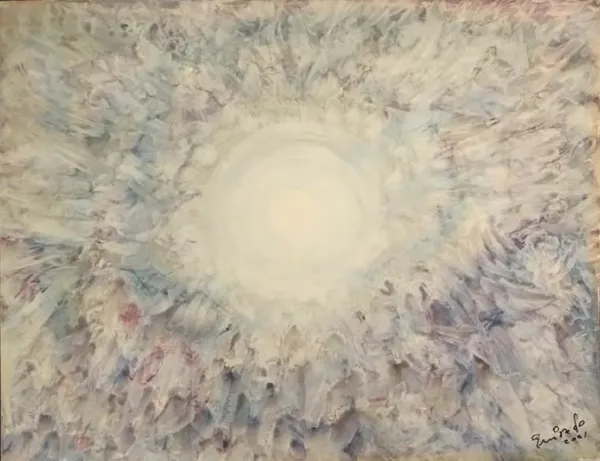
I would describe it as an intra-realist painting. It is the type of painting that one has to see with the third eye, the eye of the mind.
-
Juan Antonio Guirado Espinosa (1932–2010) was a Spanish-born painter whose work explored the intersection of perception, consciousness, and the natural world. Moving between abstraction and figuration, his practice developed into a visionary language concerned with what he described as “seeing with the third eye — the eye of the mind.”
Born in Los Villares, Jaén, Guirado began his artistic education at the age of ten in Andalusia before moving to Madrid to study at the Real Academia de Bellas Artes de San Fernando. He later continued his studies in Italy and France, engaging deeply with both Renaissance painting and French Impressionism.
In 1955, Guirado was commissioned to paint a series of murals in New York. A chance encounter while sketching in Madrid led to an exhibition at the Soler Gallery at the Fontainebleau Hotel, Miami Beach, marking the beginning of an international career that would span Europe, the United States, and Australia. Following his relocation to Australia in 1959, his work underwent a profound transformation, influenced by Oriental philosophy and mysticism, moving away from traditional representation toward a more visionary and metaphysical approach.
Although his work evolved independently, Guirado later came into alignment with the philosophical aims of Intrarealism, a movement first articulated in Florence in 1967. He is considered within academic circles as one of the principal Spanish examples of this school, his work exemplifying its central aim: to transcend surface representation and reveal the deeper, internal dimensions of reality.
The 1970s marked Guirado’s emergence on the international stage, with exhibitions across Europe and the United States and works entering significant collections, including the Museo Reina Sofía and the National Museum of Fine Arts. He exhibited at major international events, including the Chicago International Trade Expo and the Exposición Internacional Grolla d’Oro in Treviso, where he was awarded the Gold Medal.
After returning to Spain in 1983, Guirado entered a new phase of work focused on what he described as Ambientalismo (Environmentalism), producing a series of works that examined the consequences of human activity on the natural world. These paintings, often prophetic in tone, reflect a growing concern with ecological fragility, technological expansion, and the instability of contemporary life.
Throughout his career, Guirado’s work was collected by an international circle of patrons, including King Hussein of Jordan, J. D. Salinger, and John Schlesinger. His work has been the subject of critical and academic study, including a monograph by Manuel Quintanilla.
Guirado passed away in 2010 in his native Andalusia. Since then, his daughter, Catalina Guirado, has overseen the Guirado Estate, working to preserve and reintroduce his work to contemporary audiences. Recent projects include a virtual reality collaboration with FLOAT, premiered at the Coral Gables Museum during Art Basel Miami, as well as inclusion in the Cesáreo Rodríguez-Aguilera Foundation collection, where Guirado has been presented alongside artists such as Pablo Picasso, Joan Miró, and Antoni Tàpies.
Recent curatorial and academic attention — including the exhibition Parallel Visionaries, curated by Laura Revuelta, and his inclusion in a UNED programme — reflects a growing recognition of Guirado’s relevance today. His work, addressing themes of spirituality, environmental crisis, and human consciousness, continues to resonate with contemporary audiences.
-
 Juan Antonio GuiradoTunnel of Light, 200119 3/4 x 25 1/4 in.
50 x 64 cm.Oil and acrylic on paper -
Juan Antonio GuiradoFire Sunset, 199719 3/4 x 25 1/4 in.
50 x 64 cm.Acrylic on paper -
Juan Antonio GuiradoEnergy Vibration, 199519 3/4 x 25 1/4 in.
50 x 64 cm.Oil and acrylic on paper